How to Stop AI Tools from Warping Your Product Photos and Garbling Text
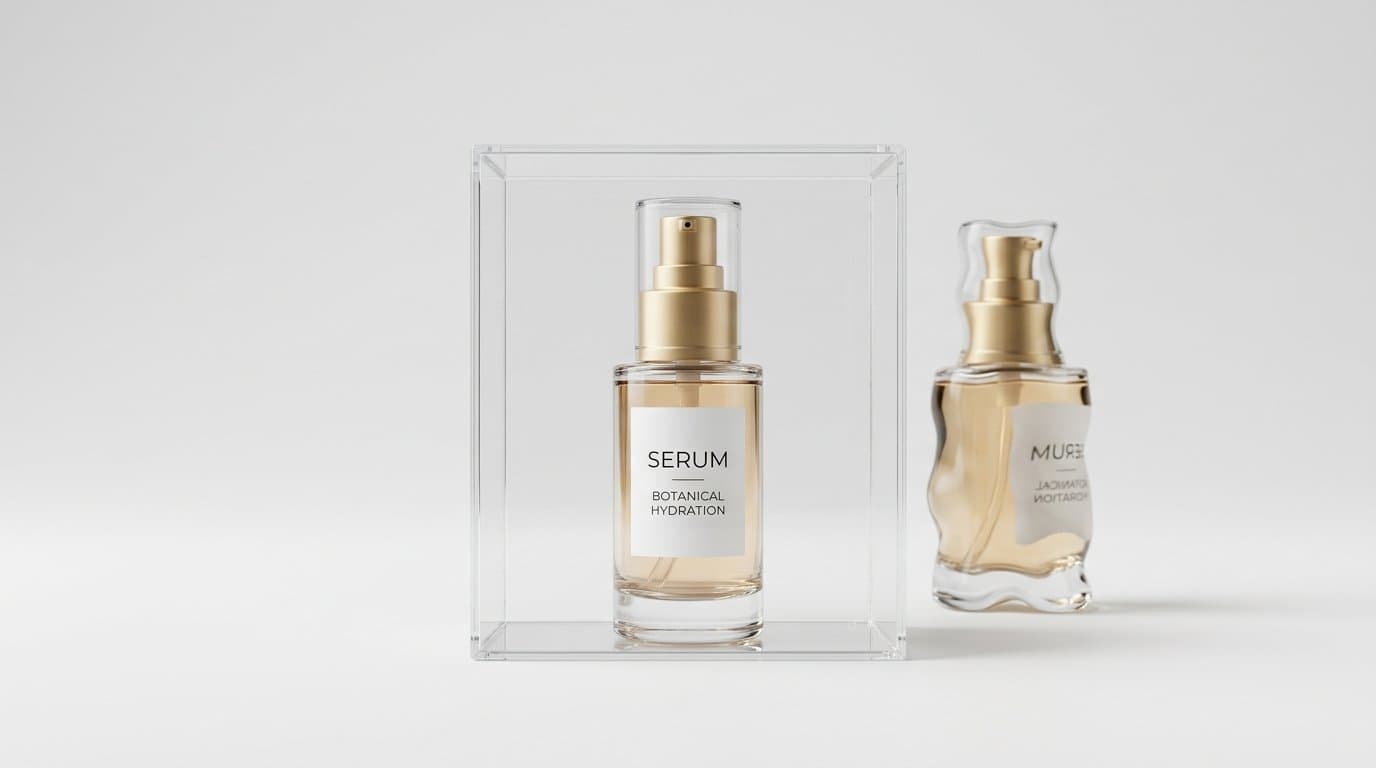
The Frustrating Reality of "Almost Perfect" AI Images
You drop a flat-lay photo of your new skincare serum into an AI generator. Thirty seconds later, the software spits out a stunning lifestyle shot. The lighting is soft and cinematic. The product sits on a flawless slab of travertine marble bathed in morning sun. Then you zoom in.
The bottle's crisp, cylindrical shape is slightly melted on the left side. The matte glass now looks like glossy plastic. And worst of all, the carefully designed label that should say "Hyaluronic Acid" now proudly reads "Hylarounc Aicd."
We have seen this exact scenario play out thousands of times.
Generative imagery has undoubtedly altered the digital merchandising pipeline, but it brought along a massive headache for retailers. Beautiful backgrounds mean nothing if the core product is compromised. If you sell physical goods, visual accuracy is not optional. It is the entire foundation of buyer trust. This current phenomenon is widely referred to in the industry as the fidelity crisis. We are seeing merchant after merchant hit a wall where they cannot actually deploy AI-generated photos because the tools keep subtly destroying the integrity of what they are trying to sell.
Understanding why these structural hallucinations happen is the first step to stopping them.
Why Generalist Models Mangle Your Merchandise
To fix the warping and garbling, you have to look at how basic image synthesis actually works.
Most mainstream platforms approach image creation holistically. They do not separate the foreground object from the background environment natively. Instead, they look at your uploaded photo and use it as a loose suggestion. The algorithm is essentially trying to predict what the entire canvas should look like pixel by pixel, relying on billions of reference images it absorbed during training.
When a standard AI model sees your supplement bottle, it recognizes a cylindrical object with text. It does not "read" the text or understand the geometry of your specific bottle cap. It just knows that cylindrical objects in natural lighting usually have certain shadow patterns, and the text-like shapes on them look a specific way.
This leads directly to feature averaging.
Feature averaging happens when the algorithm blends your specific product's traits with the visual patterns of similar products in its database. If your bespoke leather handbag has an unusual asymmetrical clasp, the AI might subtly correct it to look like a standard symmetrical clasp. The model is doing exactly what it was optimized to do. It pulls anomalies toward the mean to create a smooth, pleasing image. Unfortunately, your unique product details are the exact anomalies being erased.
The Text Hallucination Problem
Text preservation is notoriously difficult for generative networks. This is a massive pain point for any brand whose packaging heavily features typography.
Think about specialty coffee roasters, craft breweries, or wellness brands. If the AI hallucinates a flavor note on a bag of beans, the image is instantly useless. We recently spoke with a DTC operator who generated fifty lifestyle shots for a new vitamin launch. Every single one was gorgeous, and every single one misspelled "Vitamin D3" as "Vitmain D3" or turned the dosage numbers into illegible alien symbols.
Standard generators treat typography as a visual texture rather than a strict sequence of characters. When you prompt for a new background, the model repaints the edges of your product to blend it in. In doing so, it frequently overrides the text pixels.
The Rise of Identity Drift in E-commerce
You might have heard the term "identity drift" applied to AI-generated human models. It describes the creeping, unwanted alteration of a person's facial features across different generated scenes.
That exact same drift applies to inanimate objects.
If you process the same pair of sunglasses through five different scene generations without strict controls, you will get five slightly different frames. One might have thicker acetate. Another might lose the tiny metallic logo on the temple. A third might have lenses that are just a fraction too round.
Shoppers are incredibly sensitive to these subtle shifts. If a customer clicks an Instagram ad showing a chunky, oversized knit sweater but the product page features an AI-generated on-model shot where the knit looks thin and machine-made, they will bounce. The disconnect shatters their confidence in what they will actually receive in the mail. E-commerce relies on the promise that the picture matches the physical item exactly.
How Brands Try (and Fail) to Fix It
Merchants usually try a few manual workarounds when they first encounter these warping issues.
They might try writing exhaustively detailed prompts. "Keep the exact original shape of the bottle, do not change the label text, ensure the cap remains matte black." This rarely works. AI models process prompts probabilistically, not as strict surgical commands.
Another common tactic is heavy post-production. A marketer will generate the flawed AI image, open Photoshop, and painstakingly mask the original product photo back over the AI version.
There are massive problems with this manual compositing method. It completely destroys the scale and lighting integration. The original product photo usually has flat, even studio lighting, which looks absurd pasted over a dramatically lit sunset beach scene. The shadows never match up correctly with the new environment. Reflections on glossy surfaces or glass bottles still show the old studio environment instead of the new background. Finally, it requires advanced editing skills and defeats the entire purpose of automating your visual content pipeline.
The Technical Pivot: Strict Preservation Architecture
By mid-2026, the market matured. The focus shifted away from simply making pretty pictures toward guaranteeing strict anatomical preservation of the product.
Studios and developers realized that treating product photography as an art generation task was the wrong approach. It needs to be treated as a rigorous data preservation task. This led to the development of purpose-built platforms that treat the product and the environment as distinct technical layers.
Tools built for retail utilize a very different underlying architecture compared to generalist image generators. They employ methods like topological reconstruction and optical fusion to lock the source item in place.
When you upload an image to a specialized commerce tool, the system first creates an impenetrable digital fence around your merchandise. It maps the exact boundaries, the text coordinates, the structural nodes, and the material properties.
The AI is then given permission to build the surrounding environment, calculate the new lighting, and generate realistic drop shadows or reflections. However, it is strictly forbidden from altering the pixels inside the product fence.
Advancements in Label and Typography Protection
The most recent updates from specialized AI platforms tackle the text issue head-on through automatic extraction.
Instead of hoping the image generator will draw the text correctly, these systems scan the product photo upon upload and extract all visible typography using optical character recognition. They map exactly where the brand names, ingredient lists, and weight indicators sit on the packaging.
During the scene generation process, this extracted data acts as a hard constraint. The engine computes how the new environmental lighting should interact with the product's surface, but it applies those lighting changes without redrawing the lettering. The text remains pixel-perfect because it was never handed over to the generative model to interpret.
Achieving 100% Visual Accuracy Without the Headache
You do not need to settle for warped geometry or spelling errors in your product catalogs. The technology exists to get the best of both worlds: infinite creative backgrounds and absolute product fidelity.
When you are evaluating tools for your store, you have to look past the marketing examples and test them with your most difficult items.
Upload a product with complex negative space, like a wireframe chair or a delicate piece of jewelry. Try an item with tiny, crucial text, like a cosmetics jar. If the output comes back altered in any way, the tool is not suitable for a production environment.
In our experience, scaling a brand requires a visual pipeline you can actually trust unsupervised. That was the foundational idea behind Modelize. We built our app specifically to isolate and protect the core product using rigid layer controls, ensuring that Shopify merchants get hyper-realistic on-model and lifestyle shots without sacrificing a single pixel of authenticity. The environment changes, the lighting adapts, but your product remains exactly as you designed it.
As generative technology continues to embed itself in retail, the winners will not just be the brands with the most eye-catching backgrounds. They will be the brands that use AI to produce high-volume, contextual imagery that remains stubbornly, flawlessly accurate to the physical goods arriving at the customer's door. Accurate photos lower return rates. They build brand equity. And they prove to the shopper that you care about the details.
Make sure your software cares about them too.
Generate Stunning Product Photos with AI
Modelize is a Shopify app that creates professional product images in seconds - AI models, backgrounds, and more. No photoshoot needed.