Why Generative AI Is Replacing Ghost Mannequin Photography on Shopify
The End of the Floating Garment
For over a decade, the ghost mannequin ruled fashion e-commerce. You know the exact look. A crisp, perfectly shaped jacket or dress hovering against a stark white background, somehow holding human form without a human inside. It solved a massive problem for apparel brands. You needed to show how a garment draped and fit in 3D, but booking live models for thousands of SKUs simply wrecked the margins.
So, the invisible mannequin became the default.
But creating that illusion is an absolute grind. We've seen the traditional workflow up close countless times, and it is painfully manual. A stylist meticulously pins a silk blouse onto a physical modular mannequin, trying to fake natural tension. Anyone who has managed a commercial studio shoot knows that fabrics possess their own stubborn personalities. A heavy denim jacket might hang decently on a plastic torso, but a sheer chiffon summer dress requires aggressive styling just to maintain its shape. Stylists use industrial clamps, double-sided tape, and literal fishing line to manufacture the right look. If you're shooting a bulky winter puffer coat, the mannequin often disappears entirely, forcing the photographer to shoot from awkward low angles just to capture the inner lining.
Then the post-production starts. The photographer shoots the front. Then they shoot the back. Then they remove the neck piece of the dummy to shoot the inside collar. Finally, a retoucher spends hours in Photoshop compositing those separate files together to create a single, hollow shell.
It's tedious. It's expensive. The math rarely favors the merchant.
Now, a tectonic shift is happening across retail tech. As of mid-2026, 2D-to-2D generative AI draping has reached a point of absolute photorealism. Instead of spending money to erase a plastic dummy, brands are mapping their garments onto diverse, lifelike human models using software. The invisible mannequin is officially obsolete.
The Brutal Reality of Studio Costs
Let's talk numbers. Paying a traditional studio to produce high-quality ghost mannequin imagery typically costs between $40 and $100 per final image. That doesn't include the shipping of your physical inventory, the inevitable delays, or the cost of the samples themselves. If you launch a 50-piece collection and need three angles per item, you're suddenly looking at a minimum $6,000 invoice just to get floating clothes on your Shopify store.
The alternative used to be live model shoots. Those run even higher. You have day rates for talent, which easily stretch from $400 to $3,000 for agency models. You have hair and makeup. You have studio rental, catering, and styling fees.
Generative AI destroys this binary choice.
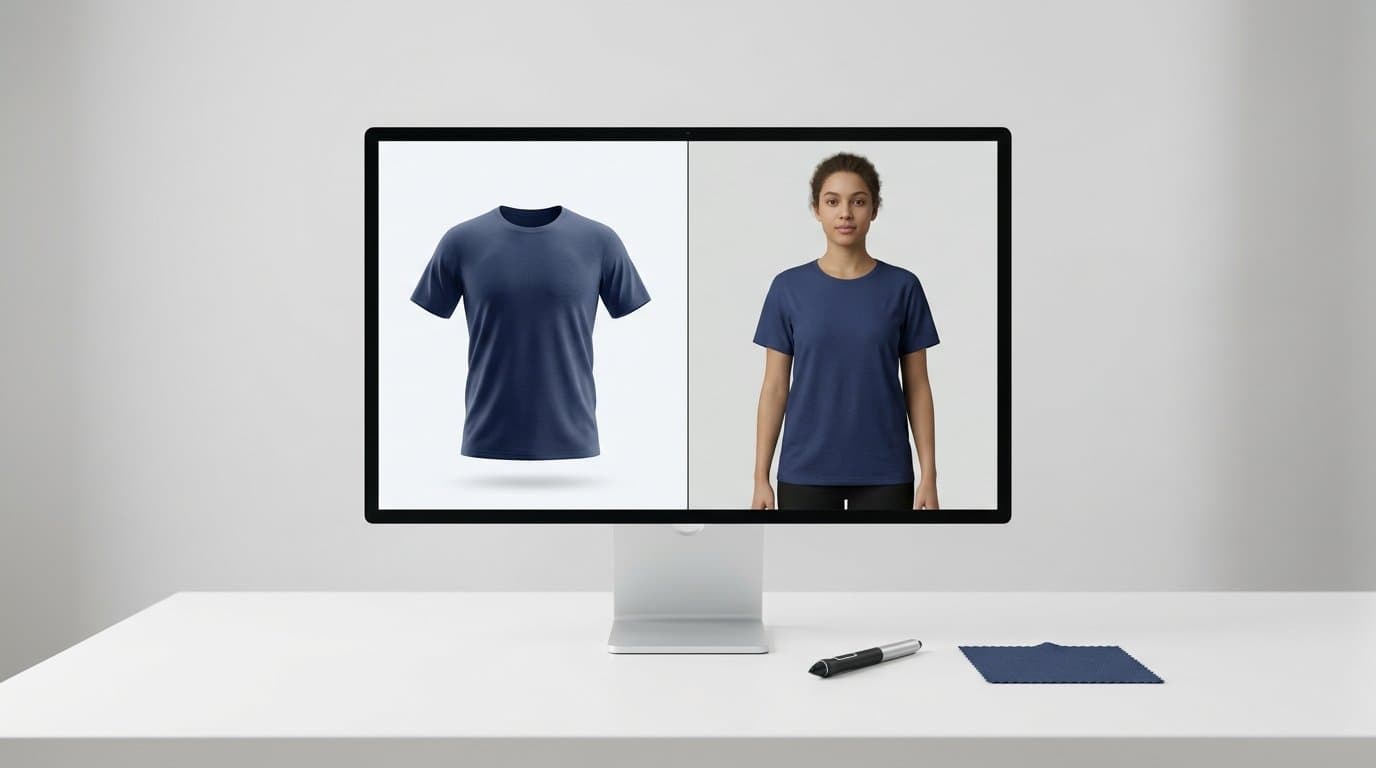
Today's workflows allow you to skip the complex pinning and compositing entirely. You can take a basic flat lay shot, or even a supplier's raw photo of a sweater on a hanger, and process it through an AI engine. The software understands the fabric tension, the lighting, and the drape. It then generates a photorealistic human wearing that exact item. Costs drop from fifty dollars an image to literal cents.
The Evolution of 2D-to-2D Draping
We didn't arrive at this point overnight. If you looked at virtual try-on software or AI fashion tech a few years ago, the results were highly questionable. Early iterations relied on complex 3D modeling. Brands had to scan their physical garments using expensive hardware, resulting in stiff, video-game-like renders that actively repelled shoppers.
By late 2024 and throughout 2025, the underlying technology completely fractured away from 3D modeling. The industry realized that 2D-to-2D image diffusion was the actual answer.
Machine learning models learned to analyze a flat two-dimensional source image. They recognized fabric weight, knit patterns, and light reflection, mapping those details onto a two-dimensional target image of a human. We are now in July 2026, and the fidelity of these models is staggering.
The AI understands that a ribbed cotton tank top stretches differently across a collarbone than a structured linen button-down. It preserves the exact placement of complex floral prints. It keeps the original shadows intact.
This breakthrough is what officially killed the ghost mannequin. You no longer need a physical object to demonstrate 3D fit because a flat image contains all the necessary data.
Why Conversions Drop When Clothes Float
Cost savings are great. Revenue growth is better. The core issue with ghost mannequin photography was never just the price tag. It was the lack of human connection.
Shoppers land on a product page with one specific question in mind. They want to know if the item will look good on them.
A floating shell of a garment forces the customer to do heavy mental lifting. They have to imagine a head, arms, and legs. They have to guess where the hemline actually hits on a 5'4" frame versus a 5'10" frame. They have to assume how a structured denim jacket might restrict shoulder movement.
When consumers struggle to visualize fit, they either abandon the cart or buy multiple sizes to return the ones that fail the mirror test.
Data backs this up. E-commerce platforms running side-by-side A/B tests consistently find that on-model product photos outperform flat lays and mannequin shots by 20 to 30 percent in conversion rate.
Real people sell clothes. Seeing how a heavy wool coat sits on actual shoulders builds immediate buyer confidence—a feeling that floating garments simply cannot replicate.
Until recently, brands accepted the lower conversion rates of invisible mannequins because they lacked the budget for continuous on-model production. That excuse no longer holds up.
Visual Merchandising at Scale
The transition to generative AI is radically changing how DTC brand owners handle visual merchandising. The flexibility is staggering.
Think about the standard rollout for a new activewear line. Under the old model, you shot the sports bra on one ghost mannequin. That single image lived on your product detail page until the item sold out.
With AI product photography, the workflow is entirely decentralized and iterative.
- You upload a simple photo of the garment.
- You generate an on-model studio shot featuring a model matching your core demographic.
- You swap the background to place that exact same model on a running track for a lifestyle hero banner.
- You then generate five more variations featuring models of completely different sizes, ages, and ethnicities to run highly targeted social ads across different buyer segments.
This level of iteration opens up localized marketing in ways that were previously impossible for independent DTC brands. If you're a Los Angeles-based swimwear brand trying to expand into the Japanese market, your default studio shots might not resonate visually with Tokyo consumers.
Normally, organizing a localized campaign requires booking a local agency, casting new models, and flying samples across the Pacific. Now, you handle it through software. You take your base flat lay and generate an entirely new set of e-commerce assets featuring Japanese models, dropping them into a lifestyle background that feels native to that demographic.
We built Modelize specifically to integrate this exact workflow directly into Shopify, allowing merchants to bypass the traditional photoshoot completely and generate professional on-model, lifestyle, and flat-lay photography in minutes. Rather than relying on rigid, isolated tools, the entire visual pipeline now lives where your inventory does.
Adjacent platforms in the wider space like Photoroom, Pixelcut, Claid.ai, Botika, and Kive.ai are also pushing the boundaries of what machine learning can do for raw image manipulation. The collective result is an ecosystem where 2D-to-2D generation is the default expectation for e-commerce operators.
The End of the Sizing Guesswork
A major driver of returns in fashion e-commerce is the sizing disconnect. Sizing charts are universally ignored. Ghost mannequins make this worse by presenting a perfectly tailored, completely unrealistic standard of fit.
Studio stylists use clips, tape, and padding to make a garment look flawless on a plastic torso. The customer receives the item, puts it on their actual, non-plastic body, and feels deeply disappointed.
Generative AI allows brands to show how clothing actually responds to gravity and human curves. Because you can generate images across diverse body types, you give shoppers an honest look at the apparel. A customer can see how a midi dress falls on a plus-size figure and a petite figure right on the same product page.
This builds immense trust. Trust reduces the friction to purchase. It also drastically cuts down the return rate, which is the silent killer of apparel margins. When people know exactly what they're buying, they keep what they bought.
Accelerating the Go-To-Market Machine
Speed matters just as much as quality in modern retail. Trend cycles are viciously fast. Fast fashion giants and viral social drops have trained consumers to expect new inventory daily.
Traditional product photography is a massive bottleneck. You wait for physical samples to arrive from overseas. Then you book the studio. Then you wait days or weeks for the retouchers to deliver the final ghost mannequin files. By the time your product page is live, the trend might already be fading.
AI workflows compress this timeline from weeks to hours.
If your factory sends a quick flat lay photo of a new cardigan prototype, you can run it through an AI generator immediately. You can build out your entire Shopify catalog, launch the pre-order page, and start running social ads before the physical shipment even clears customs.
You aren't waiting on a photographer's schedule. You aren't stressing over whether the neck joint compositing looks fake. You simply upload, generate, and sell.
The New Baseline for Fashion Brands
Letting go of established processes is always uncomfortable. Many veteran marketers and brand owners have spent years perfecting their ghost mannequin guidelines. They have trusted vendors. They know exactly how many pins it takes to make a blazer look sharp.
But the market doesn't care about legacy workflows.
Shoppers are gravitating toward brands that offer rich, diverse, photorealistic imagery. They want to see context. They want to see themselves in the clothes. The invisible mannequin was a clever workaround for a specific era of e-commerce, but that era has definitively ended.
Generative AI is not just a cheaper way to produce images. It's a fundamentally better way to merchandise apparel. We are seeing a complete changing of the guard in retail visuals. The brands that adopt 2D-to-2D draping will operate faster, spend less, and convert higher. The ones clinging to their floating garments will simply be left behind.
Generate Stunning Product Photos with AI
Modelize is a Shopify app that creates professional product images in seconds - AI models, backgrounds, and more. No photoshoot needed.