How to Upgrade Your Shopify Email Flows with AI Lifestyle Photography
The July 2026 Margin Crunch
Margins are shrinking again.
July 2026 brought a double hit to direct-to-consumer profitability that is forcing brands to reevaluate their entire retention strategy. On July 12, the USPS implemented rate hikes that pushed Ground Advantage commercial shipping costs up by an average of 11.8% [4]. Across the Atlantic, the European Union officially eliminated the €150 duty-free threshold on July 1 [5]. Now, a flat €3 customs duty applies to every single B2C low-value item entering the bloc [6].
Customer acquisition costs remain notoriously high, and these fresh logistics expenses take another direct bite out of your net profit. You simply cannot afford to pay for traffic, get a shopper to your site, and then lose them because of a weak follow-up sequence. Owned channels are your safest lifeline.
Email marketing is the obvious answer, but standard automation flows are currently stagnating across the industry. Recent 2026 benchmark data shows that the average e-commerce campaign click-through rate hovers around a meager 1.27% to 1.69% [1]. To push that number higher, you need to rethink the actual content inside those emails. Text-heavy layouts and generic product grids are no longer enough to grab a distracted shopper's attention.
According to Klaviyo's recent 2026 AI Consumer Trends Report, 85% of consumers now trust AI for personalized shopping experiences. People expect brands to understand their specific context. E-commerce marketers can capitalize on this by swapping out boring, static catalog shots for rich, AI-generated lifestyle photography tailored to exact buyer segments.
Why Your Current Welcome Flow Is Bleeding Clicks
Shoppers suffer from intense visual fatigue. They scroll past hundreds of sterile, white-background product photos on a daily basis.
Imagine a potential customer signs up for your newsletter to get a 10% discount code. They open your welcome email. Instead of seeing something inspiring, they are greeted by a grid of ghost-mannequin t-shirts or flat-lay skincare bottles they already ignored on your Instagram page. There is zero new visual information to spark desire. They close the app, and you lose the sale.
Context triggers the conversion. A sterile product shot of an SPF moisturizer tells the buyer what the bottle looks like. An image of that exact same bottle resting on a sun-drenched pool deck next to a pair of polarized sunglasses tells a story.
When a buyer in Miami is looking for summer apparel, they need beach context. A buyer in Seattle shopping for the same brand needs to see gloomy-day studio lighting or cozy indoor aesthetics. Sending the exact same wholesale line sheet to both of them is lazy merchandising.
The Psychology of Contextual Commerce
Why do lifestyle images consistently outperform basic catalog shots in email campaigns? They significantly reduce cognitive load.
When a shopper sees a white-background photo of a mid-century modern accent chair, their brain has to do the heavy lifting. They have to mentally place that chair into a living room, imagine the lighting, and guess how it pairs with a rug. That mental friction delays the purchasing decision.
Placing that chair into a beautifully rendered, realistic room instantly removes the friction. You are doing the imagination work for the customer. They no longer have to guess what the product feels like in the wild.
We see this constantly in our own testing. Brands spend massive budgets driving high-intent traffic to their storefronts, only to follow up with abandoned cart emails that look like inventory spreadsheets. Upgrading those emails with context-rich photography bridges the gap between passive interest and active desire.
Matching the Visual to the Buyer Segment
Stop sending the exact same photos to everyone on your list.
Visual segmentation allows you to group your audience based on data and serve them imagery that actually resonates. We recommend breaking your email list into specific cohorts for targeted photography:
- Geographic climate targeting: Send cozy winter cabin backgrounds to your northeast buyers in December. Serve bright coastal beach setups to your Florida and Southern California segments.
- Aesthetic preference via past purchases: If a customer strictly buys neutral, minimalist apparel, avoid sending them cross-sell emails featuring chaotic, neon-lit urban environments. Match their established vibe.
- Loyalty tier exclusivity: Reward your highest-spending VIP customers with emails that look like a high-end editorial magazine.
- Abandoned cart context: Show the exact left-behind item being used in a real-world scenario to generate immediate purchasing urgency.
Deep visual merchandising like this used to require an astronomical production budget. You had to fly a crew to Miami for the beach shots, rent a Brooklyn loft for the urban shots, and hire multiple models to cover your demographic bases. That barrier to entry is completely gone.
Fixing the Unit Economics of Content Creation
Generative AI changes the entire math equation behind content production. You do not need a massive budget or a full-time creative agency to execute this strategy.
Instead of booking a dozen different photoshoots, you can generate hyper-specific lifestyle photography from a single source image. Using a Shopify app like Modelize, you can take one standard catalog flat-lay and spin out dozens of localized, context-specific lifestyle shots in minutes without booking a single studio.
Other marketers might try hacking this process together by running images through Photoroom for basic background removal, or spending hours searching Kive.ai for moodboard inspiration. Direct AI generation tailored specifically for your e-commerce catalog removes the friction entirely.
Let's look at a practical example. Imagine you sell matte ceramic cookware. You upload a basic, top-down photo of a green frying pan. You apply a specific prompt for a bright, sunlit marble kitchen counter at 9 AM with fresh eggs and a linen towel. Within seconds, you have a highly realistic, styled image that fits perfectly into a Sunday morning newsletter blast. The cost per asset drops to pennies.
Tailoring the On-Model Experience
Apparel merchants face the toughest visual challenges and the highest return rates in the industry. Showing a dress on a plastic mannequin does absolutely nothing to help a customer visualize the fit.
Showing that same dress on a diverse range of AI-generated models helps different customer segments actually see themselves wearing the garment. If your data shows that a specific segment of your audience frequently purchases petite sizes, you can generate lifestyle images featuring petite models specifically for their promotional emails.
You can also adjust the styling of the model to match the season. A lightweight cotton button-down can be styled on a model wearing shorts for a July campaign, and then the exact same shirt can be generated on a model wearing layered autumn coats for an October email. You extend the lifecycle of your core products without organizing a reshoot.
Upgrading Your Most Profitable Flows
The best way to see an immediate return on AI photography is to inject it straight into the automated sequences already running in your Klaviyo or Omnisend account.
The Welcome Series Revamp
Your welcome flow serves as your digital storefront window. The first email typically delivers a promised discount code accompanied by a generic hero banner.
Try swapping that hero banner based on the traffic source that captured the lead. If a subscriber signed up via a TikTok ad showing a rugged outdoor camping trip, their specific welcome email should feature your product in a forest or mountain setting. If they converted from a Pinterest ad focused on clean home organization, generate a modern interior lifestyle shot. Visual continuity keeps the new subscriber engaged and confirms they are in the right place.
Rethinking the Abandoned Checkout
This is the highest-intent email you will ever send. The classic format relies entirely on dynamic product blocks that pull a transparent PNG straight from your Shopify database. The copy usually reads something like, "You left this behind!"
Change the format. Take the primary product left in the checkout and use AI to render it in an aspirational environment. If a shopper leaves a leather weekend duffel bag in their cart, generate a photo of that exact bag sitting in the open trunk of a vintage car or resting on an airport terminal seat. Make them visualize the trip they are about to take. You are no longer selling a bag. You are selling the vacation.
The Post-Purchase Cross-Sell
Do not abandon the visual experience just because the customer completed a purchase. The post-purchase flow is your best opportunity to increase lifetime value.
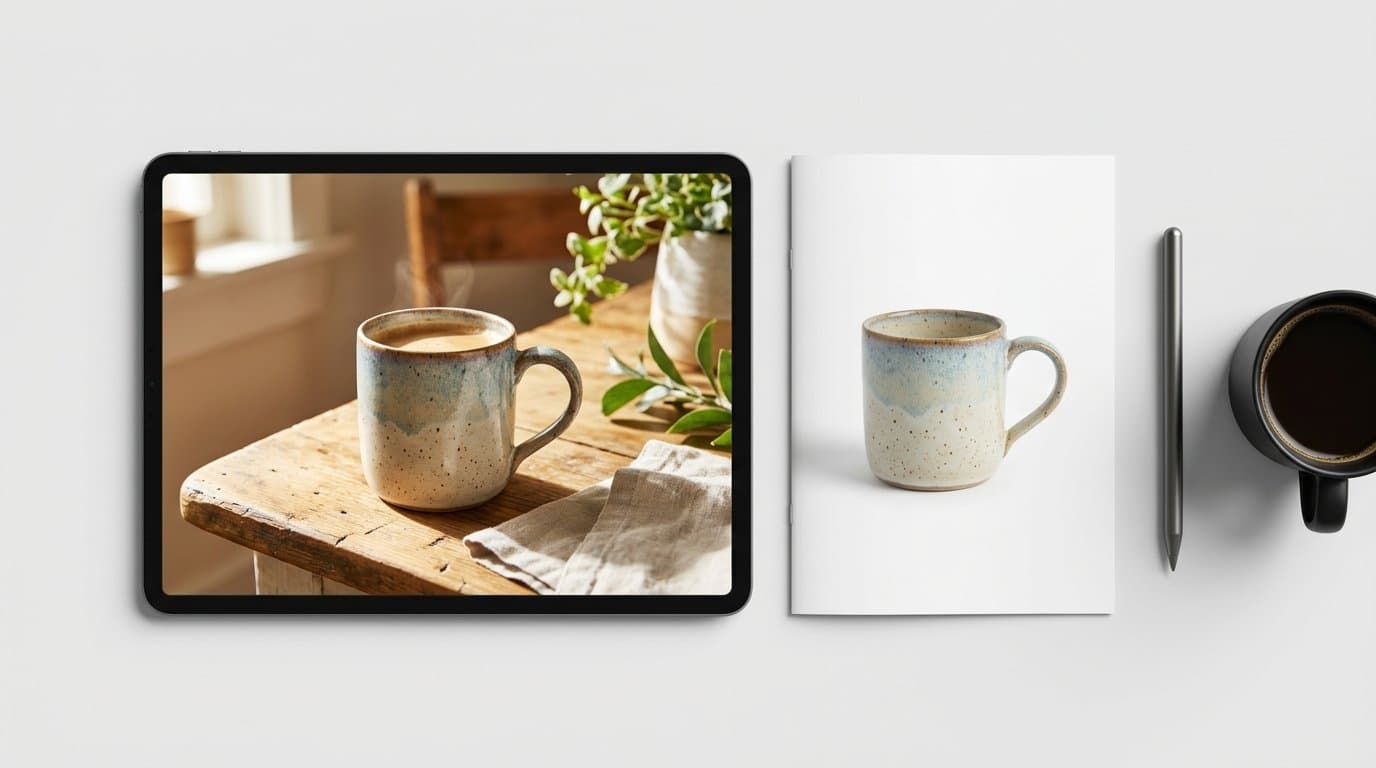
If someone buys a ceramic coffee mug, follow up two weeks later with an email recommending your matching pour-over kettle. Instead of showing the kettle by itself, use AI to generate a cozy morning scene featuring both the mug they already own and the kettle they need to buy. Showing the two items interacting together in a natural setting makes the upsell feel organic and necessary.
How to Roll This Out This Quarter
Do not try to overhaul your entire email marketing strategy overnight. Start small to prove the concept.
Pick your highest-traffic automated flow. For most e-commerce brands, this will be the first message in the abandoned cart sequence. Set up a straightforward A/B test.
Group A receives your classic email with the standard dynamic product block and white-background image. Group B receives the exact same copy, but the product image is replaced with an AI-generated lifestyle shot matching the item in their cart.
Let the test run for two to three weeks depending on your traffic volume. Watch your click-through rates closely. Pay special attention to the revenue per recipient metric. In our experience, once a brand sees the conversion lift from contextual imagery, they rarely go back to standard studio shots.
Insulating Your Brand Against Rising Costs
The operational realities of e-commerce are getting tougher. With USPS shipping rates climbing and international duties eating away at cross-border margins, every single click you generate from an owned channel carries immense weight.
You cannot control postal regulations or European trade policies. You can control the visual experience you deliver directly to your customers' inboxes. Consumers are highly receptive to personalized, AI-driven experiences. Stop relying on the exact same generic photography your competitors are using. Build a dynamic visual strategy that speaks directly to the person opening the email, and watch your retention metrics reflect the effort.
Generate Stunning Product Photos with AI
Modelize is a Shopify app that creates professional product images in seconds - AI models, backgrounds, and more. No photoshoot needed.