How to Spot AI Return Fraud and Fake Damaged Product Photos on Shopify
The Reality of Synthetic Return Abuse
Trusting a customer photograph used to be standard operating procedure. A shopper emails you a picture of a shattered ceramic vase or a severely dented shipping box. Your support team takes one look, clicks a button in Shopify, and issues the refund. You eat the cost of the damaged goods, but you save money on return shipping and keep the buyer happy.
That entire system is breaking apart right now.
According to a TechRadar report published today, August 12, 2026, AI image generation tools have completely democratized retail refund abuse. The barriers to entry for friendly fraud are officially gone. Anyone with a smartphone can now upload a perfectly fine product photo to an AI editor, type "add a large tear to the fabric" or "make the glass look cracked," and submit the hallucinated result as proof of damage.
The financial impact is staggering. The National Retail Federation estimates that retail returns recently hit $849.9 billion, with e-commerce absorbing a massive chunk of that volume. Fraud and policy abuse are rising right alongside those numbers. The Merchant Risk Council reports that 57% of merchants have seen a spike in policy abuse. We are seeing a coordinated shift from opportunistic fibbing to automated, synthetic deception.
Why Visual Proof is Failing DTC Brands
Most independent Shopify merchants built their customer service workflows around friction reduction. You want to trust your buyers. Asking someone to pack up a leaky bottle of shampoo or a shattered mirror and drive it to a UPS store feels like terrible customer service.
Fraudsters know exactly how these workflows operate. They target inexpensive or cumbersome items where the merchant is likely to authorize a "returnless refund."
We recently observed a scenario involving a popular brand making durable EVA tote bags. A customer complained about a twisted strap and sent a photo. The support team explained how to untwist it. Minutes later, the buyer sent the exact same photo back, but this time a massive rip had magically appeared in the material. It was an obvious AI manipulation. The physics of how the digital material tore didn't match the real-world properties of molded EVA.
These attempts are rarely isolated incidents. Sophisticated refund rings use generative models to alter single source photos in dozens of different ways, submitting claims across multiple dummy accounts.
How to Spot AI-Generated "Damage"
Because we build AI product photography tools at Modelize, we spend our days analyzing how machine learning models render light, texture, and geometry. Our platform generates highly realistic on-model and studio shots for merchants, which means we know exactly where generative algorithms tend to fail when they are used maliciously by amateur fraudsters.
You don't need a computer science degree to catch a synthetic refund claim. You just need to train your support team to look for specific visual anomalies.
Inconsistent Lighting and Missing Shadows
When a fraudster uses an inpainting tool to add a crack to a ceramic mug, the AI usually struggles to match the ambient occlusion of the original photo. Look closely at the newly generated "damage." A real dent in a cardboard box casts a specific, directional shadow based on the lighting in the room. AI-generated dents often look flat or have shadows falling in the opposite direction of the main light source. The altered area might appear slightly blurry or artificially sharp compared to the rest of the image.
Garbled Packaging Text
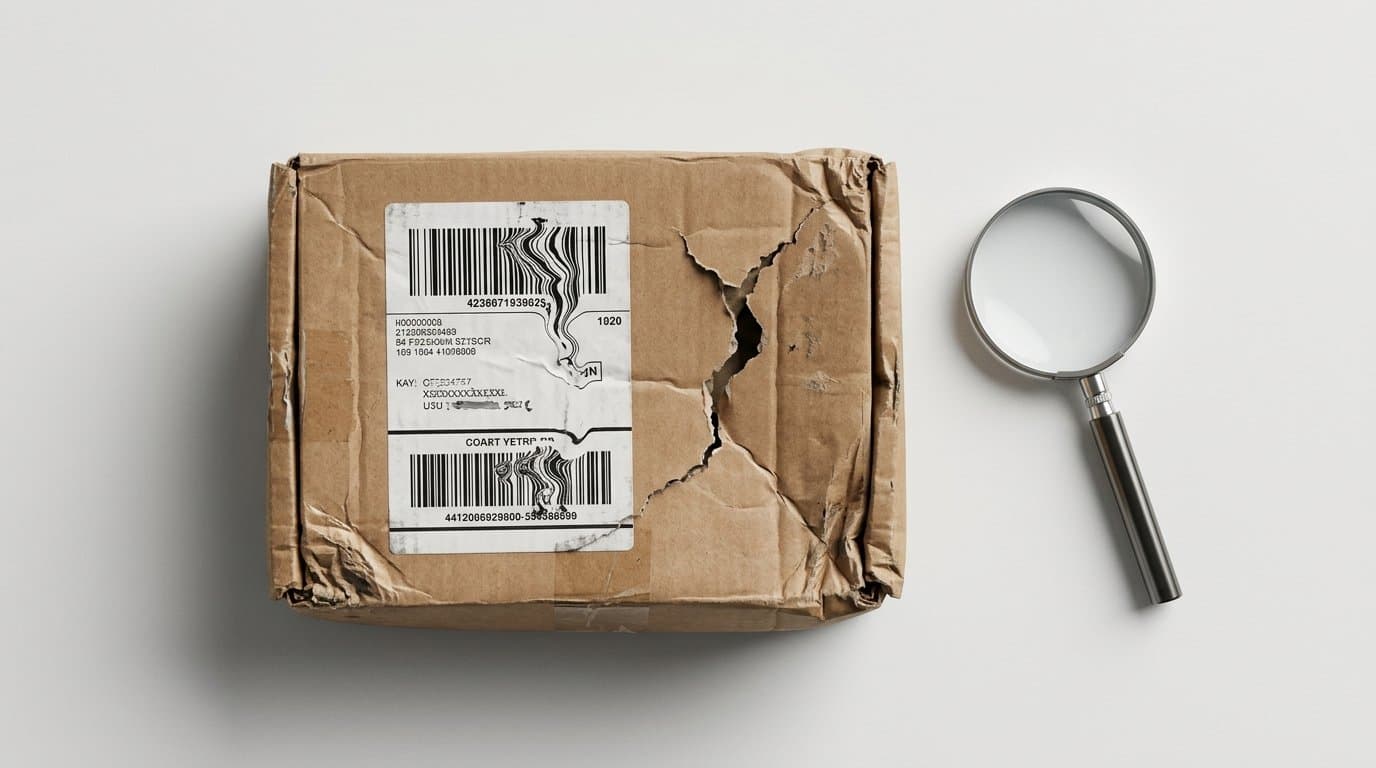
Generative models still have a hard time preserving small, background text when altering an adjacent area. If a customer claims their skincare serum leaked all over the box, check the ingredient list or barcode right next to the "leak." If the text suddenly turns into alien hieroglyphics or the barcode lines melt together, the image was likely run through a diffusion model.
Impossible Material Physics
Pay attention to how things break. Heavy corrugated cardboard snaps and bends with visible fibrous layers. Cheap AI tools often render cardboard tears looking like torn tissue paper. Glass shatters with sharp, geometric facets, but AI might render a cracked screen with soft, wobbly lines that look more like melted plastic.
Repeated Backgrounds Across Different Claims
Fraud rings get lazy. They will take one authentic photo of a product resting on a specific kitchen counter and use AI to generate five different types of damage on that same image. If your support team notices the exact same granite countertop grain and lighting setup across multiple claims from different user accounts, you are dealing with a coordinated attack.
Updating Your Shopify Return Workflows
Training your eyes is only the first step. You actually have to change how your store processes returns. Continuing to rely exclusively on static photos for immediate refunds is a massive liability.
Demand Video for High-Value Claims
Photos can be manipulated in seconds. Video generation is advancing quickly, but creating a convincing, high-resolution video of a damaged product that holds up to scrutiny is still too much work for the average refund abuser. Update your policy to require a short video showing the damaged item from multiple angles for any claim over a specific dollar threshold. Ask the customer to physically rotate the product.
Implement Mandatory Return Audits
You do not have to abandon returnless refunds entirely. They still make financial sense for low-margin items where shipping costs eat the whole product value. Instead, introduce a randomized audit system.
Force a physical return on a random 15% of all damage claims. Inform the customer that the item must be shipped back to your warehouse for quality assurance testing before the refund is processed. Fraudsters typically abandon the claim immediately when asked to produce the physical item. They simply move on to a softer target.
Check Image Metadata
When a customer uploads a photo directly from their iPhone, the file contains EXIF data detailing the camera model, timestamp, and location. Images saved out of AI generation platforms or manipulated in web apps often have their original metadata stripped or replaced.
Train your customer experience agents to check the file properties of suspicious uploads. If a photo claims to have been taken five minutes ago but lacks basic smartphone EXIF data, pause the refund. Ask the buyer to provide the original, unedited file.
Adjust Your Customer Support Scripts
Fraudsters use aggressive tactics to pressure support agents into quick resolutions. They rely on the agent's desire to close the ticket and avoid negative reviews.
Rewrite your macros. Shift the tone from immediate compliance to structured investigation. A response like "I am so sorry to hear this arrived damaged; please allow our quality control team 24 hours to review these images so we can prevent this issue in the future" buys you time. It signals to the buyer that their claim is undergoing actual scrutiny.
The Operational Reality
Friendly fraud is no longer just a few bad apples trying to get a free t-shirt. The commercial availability of synthetic media tools has turned refund abuse into a high-volume, automated threat.
Your support team is the front line. Arm them with the right knowledge. Show them examples of hallucinated packaging and badly rendered shadows. Give them the authority to push back on suspicious claims. E-commerce margins are tight enough without subsidizing artificial damage. Protecting your revenue requires adopting a far more skeptical approach to visual evidence.
Generate Stunning Product Photos with AI
Modelize is a Shopify app that creates professional product images in seconds - AI models, backgrounds, and more. No photoshoot needed.