Multi-Angle Product Photography: Why One Shot Is Never Enough
The Limitation of a Single View
A single product photo is a two-dimensional representation of a three-dimensional object. No matter how well-lit or beautifully styled, one image can only show one perspective. The customer sees the front of a backpack but wonders about the side pockets. They see the top of a pair of shoes but can't tell how the heel looks.
This information gap creates hesitation. And hesitation kills conversions.
Research from the Baymard Institute found that 56 percent of online shoppers leave a product page if they can't see the product from enough angles. Not because the product isn't right — because they can't confirm it's right. One image forces customers to guess, and most customers won't spend money on guesses.
How Many Angles Do You Actually Need
The ideal number of product images varies by category, but the general recommendation is five to eight images per product. Here's what that typically includes.
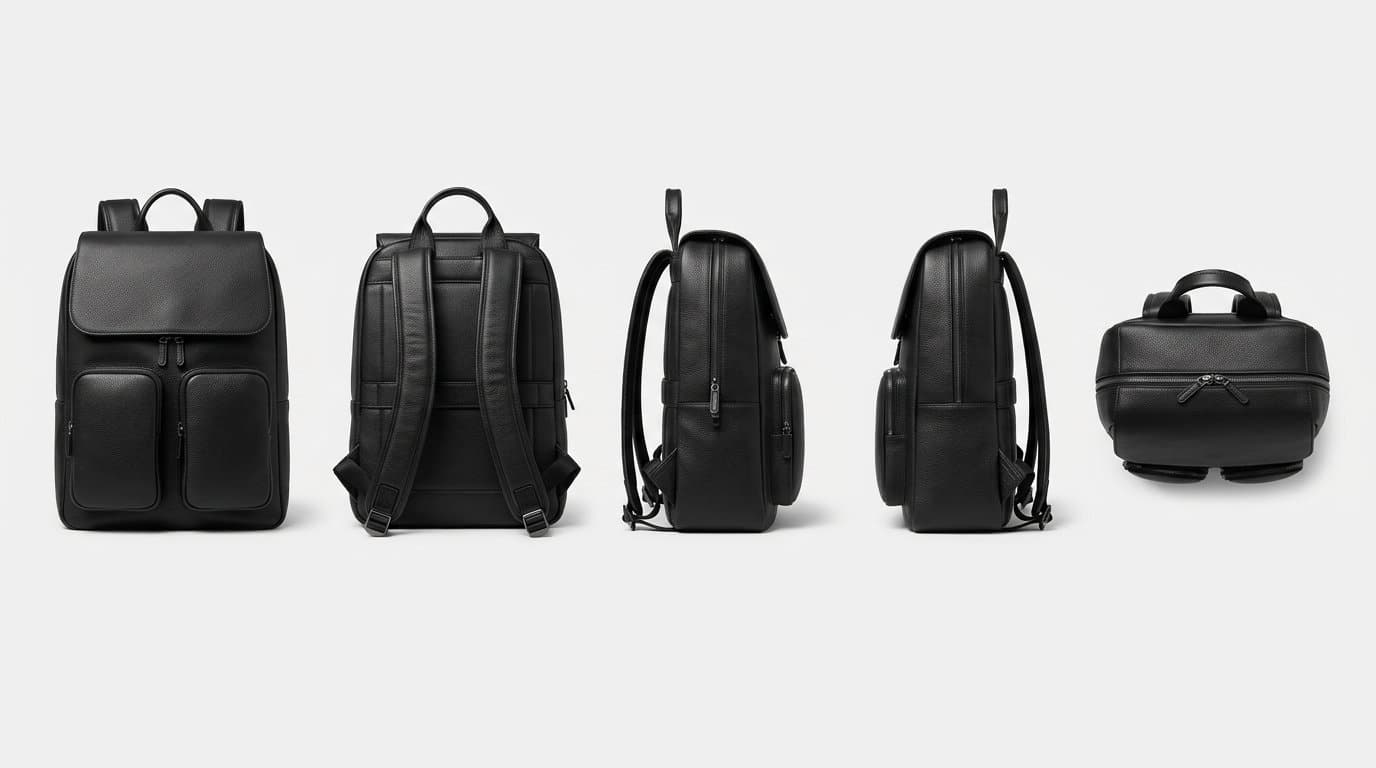
A hero shot — the primary front-facing view that appears in search results and collection pages. This image carries the most weight and should be your best shot.
A back view showing construction details, labels, patterns, or features that aren't visible from the front. For apparel, this includes how the garment fits from behind. For electronics, it shows ports and connections.
Side views from both the left and right that reveal the product's depth, profile, and any lateral features. These are critical for three-dimensional products where shape matters.
A top-down or overhead view that works well for products with notable top features — bags with visible compartments, shoes showing the sole pattern, or boxes displaying top branding.
Detail close-ups that highlight material quality, texture, stitching, buttons, clasps, or any feature that communicates craftsmanship and quality.
A scale or in-use shot that shows the product being held, worn, or placed alongside familiar objects so customers can accurately judge size.
The Direct Impact on Returns
Return rates are one of the biggest profit drains in e-commerce, and product imagery is one of the most controllable factors. When customers receive products that don't match their visual expectations, they return them.
Multi-angle photography directly addresses this problem. By showing the product from every relevant perspective, you set accurate expectations. The customer knows exactly what the back looks like, how thick the material is, and how large the product actually is before they buy.
Stores that upgraded from single-image listings to comprehensive multi-angle galleries report return rate reductions of 15 to 25 percent. In fashion specifically, where return rates regularly exceed 30 percent, the impact of complete visual information is even more dramatic.
Capturing Consistent Multi-Angle Shots
Consistency across angles matters as much as the angles themselves. When the lighting, background, and color balance shift between views, the customer's brain registers incongruity — which feels unprofessional even if they can't articulate why.
Use a turntable or marked floor positions to rotate the product while keeping the camera fixed. This ensures identical framing, distance, and perspective across all angles. Mark your camera position, height, and angle so you can replicate the setup across your entire catalog.
Maintain identical lighting for every angle. This is where studio lighting outperforms natural light — you can control every variable and reproduce it perfectly every time.
360-Degree Photography
Some stores go beyond multiple static angles to offer interactive 360-degree views. These are created by photographing the product at regular intervals — typically 24 to 36 shots around a full rotation — and combining them into a spin animation.
360-degree views give customers complete control over how they examine the product. They can rotate it freely, stopping at any angle for closer inspection. This interactive experience has been shown to increase conversion rates by 10 to 40 percent depending on the product category.
The trade-off is production cost. Traditional 360-degree photography requires a motorized turntable, consistent lighting, and software to stitch the images together. For large catalogs, the time investment is substantial.
AI-Generated Multi-Angle Views
This is where AI offers a transformative advantage. Instead of physically photographing every angle of every product, AI can generate additional views from a limited set of source images.
Upload a front shot and a back shot, and AI can generate side views, three-quarter angles, and detail crops that are photorealistic and consistent with your existing imagery. This dramatically reduces the number of physical shots needed while still providing customers with comprehensive visual information.
With Modelize, you can generate lifestyle angles, on-model views, and contextual shots from your existing product photos. A single flat-lay photograph of a dress becomes a multi-image listing showing the dress on a model from the front, side, and back — all without additional photography.
Prioritizing Angles by Product Type
Not every product needs the same angles. Prioritize based on what information matters most for each category.
Apparel needs front, back, and side views on a model or mannequin, plus detail shots of fabric texture and closures. The fit from different angles is often the deciding factor in purchase decisions.
Shoes need front, side, back, top, bottom, and a three-quarter angle. Customers want to see the sole construction, the profile shape, and how the shoe looks from the angle they'd see in a mirror.
Jewelry needs close-up details at multiple angles, often with magnification to show craftsmanship. Scale shots showing the piece worn on a hand, neck, or ear are essential for size communication.
Electronics need every functional side shown — ports, buttons, screens, and connections. Overhead views showing the exact footprint on a desk or shelf help customers assess whether the product fits their space.
Image Gallery Best Practices
The order of images in your gallery matters. Lead with your strongest hero shot. Follow with the most informative angles — those that answer the most common customer questions. Save detail shots and lifestyle images for later in the gallery.
Make your images zoomable. Customers examining specific details need to zoom in, and a 1000-pixel-wide image becomes blurry when expanded. Shoot at the highest resolution available and maintain at least 2000 pixels on the longest edge for comfortable zooming.
Keep aspect ratios consistent across all images in the gallery. Mixing landscape, portrait, and square crops creates a jarring browsing experience. Choose one ratio — square is the most versatile — and crop all angles to match.
The ROI of Complete Product Visualization
Investing in multi-angle photography pays dividends across several metrics. Higher conversion rates from customers who have enough information to buy with confidence. Lower return rates from customers who received exactly what they expected. Fewer customer service inquiries asking about specific product details that images would answer.
The cost of comprehensive multi-angle photography — whether captured traditionally or generated with AI — is consistently outweighed by the improvements in these metrics. In a business where visual information is the primary communication channel, more and better angles mean more sales and fewer problems.
Generate Stunning Product Photos with AI
Modelize is a Shopify app that creates professional product images in seconds - AI models, backgrounds, and more. No photoshoot needed.